Posts

Showing posts with the label history

Flying Starfish

Image
Like 'Goodbye Global Warming', 'Flying Starfish' didn't tickle the editorial fancy either. Not contentious but possibly a bit too similar in style the the previous Apollo anniversary articles perhaps. Again, I'm including it here so you can make up your own mind. Nearly 400 million years ago, a 3 foot long half-lizard, half-fish pulled itself out of the ocean and went for a walk on a muddy, equatorial shore. Lurching forward on limbs more fin than foot and dragging its tail along the ground it continued on for about 45 feet and then… And then we don’t know. That short, indistinct trail of prints and tail are all that we have, preserved now in rock at the edge of the island of Valentia off the East coast of Ireland. The creature was a tetrapod. Evolved during the Devonian period, it was one of the earliest known animals to leave behind the warmth and safety of the sea to brave the unknown danger of the harsh, dry land. These proto-amphibians became the ancestors ...

Paper Rockets

Image
I hope you’re reading this on some obscure history blog sometime in t he  22 nd Century, smiling wryly at my lack of foresight as you Hyperloop across Mars,  past Calrketown, Saganville and New Bezos on your way to Muskbury. I really hope you   are because I’d like nothing better than to be proved conclusively wrong with this crazy idea – maybe Space X won’t get us to Mars. If they don’t, it wouldn’t be the first time the space dream has come crashing to earth. This article –  ‘Paper Rockets’  and the one that follows –  ‘The Interplanetary Marshmallow Test’  – were published in the British and US Mensa magazines to coincide with the 50th anniversary of the Apollo Moon landing. Though different, they have some overlapping themes and language so I hope you’ll forgive any similarities. A giant, 50 metre tall rocket with the lifting power of four Saturn V’s, fully reusable and capable of putting 500 tons into orbit every flight. B...

Memento Vitae

Image
“Almost every sentient being who ever lived belonged to a society that doesn’t exist any more. Why should we be any different?”                                  Alastair Reynolds. The one thing history tells us about civilisations is that they fall. The bronze age collapse left centuries-old Egyptian, Babylonian, Hittite and Mycanean civilisations with their cities in ruins and their peoples scattered. The glory that was Rome was snuffed out by barbarian swords and even the original British Celtic culture was extinguished by those Johnny-come-lately Angle and Saxon immigrants. Babylon’s Ishtar Gate (Pergamon Museum, Berlin) was constructed 2,500 years ago. It’s builders probably   believed – much as we do – that such a rich and powerful civilisation could never vanish. Whether you call it archaeology or grave robbing, one of the few ways we have of discovering how those ancient peoples li...

Climbing Mount Rumsfeld

Image
Somewhere in my house, quietly turning to coal under a pile of papers, is a ‘planetary calculator’ (astronomy stats on two sliding pieces of cardboard), a free gift with the second issue of Star Lord comic in May 1978. Shifting the display to Pluto confidently declares that world to be moonless – as well established a fact as nearly 50 years of observations with the world’s biggest telescopes could make it. Since then, the Hubble telescope as well as the New Horizons probe fly-by has produced terabytes of data on the size, composition, orbits, shape, appearance etc of Pluto’s five moons. A torrent of brand new information that nobody in that May of 1978 had any reason to expect even existed. In Donald Rumsfeld’s immortal words, Pluto’s moons were an unknown unknown. How much has yet to be discovered? What unknown unknowns lie before us? Just how high does Mount Rumsfeld go? It’s those unknown unknowns that trip us up. We are in the position of a mountain climber who can only look down....

The Magic Watch

Image
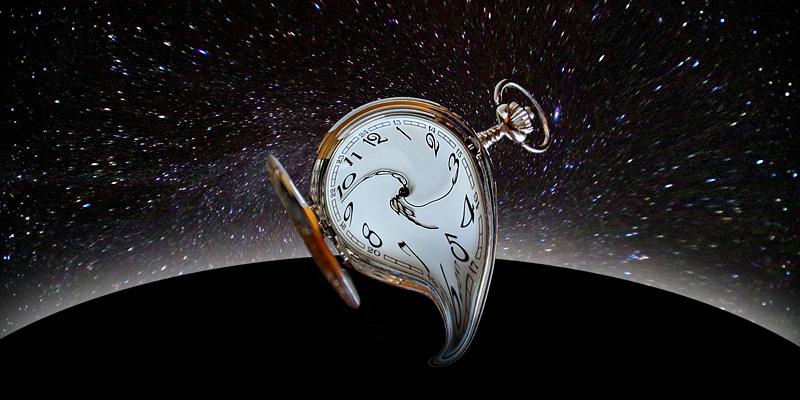
In a minute I’m going to tell you the only scientifically proven way to stay young (you’re not going to like it though) and I’ll use my magic pocket watch to explain how it works. The watch is indestructible and I always know what time it says no matter how far away it is. The singularity at the heart of Black Holes is where our understanding of physics breaks down, but what if they don’t exist? Say I leave my watch at my house by the sea and go live on a high mountain. After a little while I will notice that my magic watch (which I can magically still see) will be running ever so slightly slow compared to my wristwatch. The longer I stay up the mountain, the slower my magic watch will run. Slower by some millionths of a second only but slower. The reason is not the sea air but gravity. Living on a mountain, I am ever so slightly further away from the gravity created by the mass of the Earth while the magic watch – at sea level – is deeper in the Earth’s gravity field and runs slower b...

Biff Tannen Got the Better Deal

Image
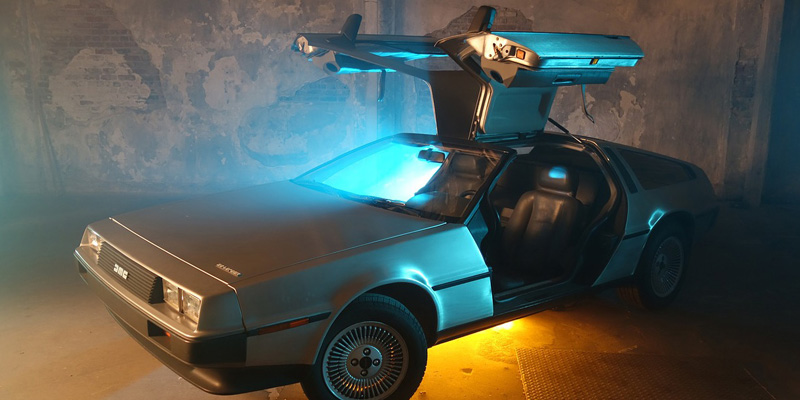
This is a bonus article from before I started the ‘Crazy Idea’ series. Written to coincide with the 30th anniversary of ‘Back to the Future’, it never saw publication but many of the ideas were developed into the ‘Progress is Bunk’ article. Not the fictional Biff of course. In the film Marty got the bright future and Biff got … well, you’ve seen the movies. No, I’m talking about the real Biff Tannens – the teenagers of 1955 compared to the teenagers of McFlys era, from 1985 to now. Of course, the actual 2015 hasn’t turned out like the one Marty visited. Nobody every really expected the flying cars, hoverboards or instant pizza but 1985’s Marty McFlys did expect their future to be full of wonders. The ‘accelerating rate of technological change’ was already a truism that pretty much guaranteed it. Photo: Dave Tavres, Pixabay. Except it didn’t. Everywhere we’re told that things are changing faster and faster driven by ever accelerating technology. Moore’s Law and exponential curves are mo...